Better digital experiences start with clear thinking.
I help businesses make websites and digital products easier to understand, easier to use, and better aligned with what they need to accomplish.
SERVICES
WHAT I DO
Two kinds of work.
One strategic lens.
Some projects begin with a website. Others begin inside a product. In both cases, the work starts by understanding what people need, what the business needs, and where the experience can work better.
Website design
Make the website easier to understand and act on.

Website strategy and experience planning
Information architecture and navigation
Wireframes and responsive page design
Landing pages and conversion paths
Content structure and messaging hierarchy
Accessibility-minded design
Design systems and reusable components
Developer collaboration and design QA
For businesses that need a stronger digital presence, clearer messaging, better navigation, or a more effective path from interest to action.
PRODUCT UX
Make complex products
feel simpler to use.
UX research and synthesis
User and customer journey mapping
Complex workflow redesign
Information and data presentation
Wireframes and interactive prototypes
Interface and interaction design
Design systems and component strategy
Usability testing and iteration
For teams improving SaaS products, platforms, dashboards, workflows, and digital tools where complexity has started to get in the way.
Where I look when the experience needs work.
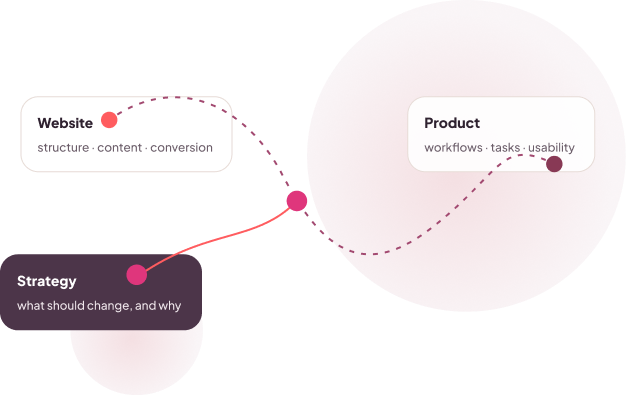
Not every issue starts on the screen. Sometimes the problem is content. Sometimes it is structure. Sometimes it is a workflow that grew more complicated over time.
Website work
Messaging, navigation, structure, clarity, conversion paths.
Product work
Tasks, workflows, decision points, usability, systems.
Strategic layer
User needs, business goals, priorities, and what should change first.
The work should improve something you can feel.
This is not just about cleaner screens. It is about making the experience clearer for users and more useful for the business.
Clearer paths
People understand what to do next and how to move through the experience.
Stronger digital presence
Websites feel more polished, more credible, and more aligned with the business.
Better decisions
Research and strategy help the team make clearer product and design choices.
Simpler workflows
Tasks, decisions, and information feel more manageable inside the product.
A clear path, without process theater.
Enough structure to move things forward. Enough flexibility to solve the right problem.
Understand
Start with goals, users, constraints, analytics, and what the team already knows.
Prioritize
Identify the patterns, friction points, and decisions that matter most.
Design
Translate the strategy into structure, flows, content, wireframes, and interface design.
Support
Work with your developer or team, QA the experience, and help it land well.
Budget shouldn't be a mystery.
I scope work around the problem, the team, the timeline, and the level of support you need. We talk about budget early, before either of us invests heavily in the process.
If you already have a budget range, tell me. It helps me recommend the right level of work instead of designing a scope that is unrealistic for you.
Focused engagement
A defined UX problem, landing page, workflow, research synthesis, or design review.
Project engagement
A website redesign, product workflow redesign, information architecture, or end-to-end UX/design effort.
Ongoing UX support
Senior UX guidance, design reviews, product support, and collaboration with an existing team over time.
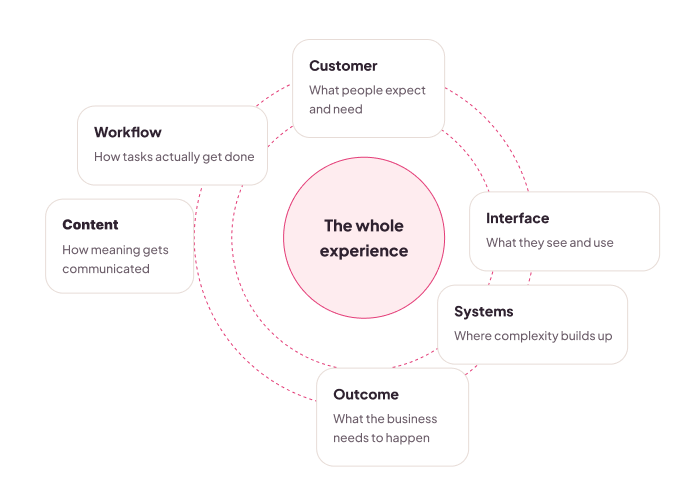
The work behind a better experience.
The interface is where people feel the experience.
The strategy starts earlier.
Why this matters
It helps avoid surface-level redesigns that look nicer but do not actually fix the experience
UX research & synthesis
Turn interviews, analytics, and existing research into useful design decisions.
Information architecture
Organize pages, content, navigation, and pathways so people can find what matters.
Journey mapping
Understand the experience across touchpoints rather than treating each screen as an isolated problem.
Workflow design
Simplify complex tasks and decisions without losing the information people actually need.
Content strategy
Create stronger hierarchy, clearer messaging, and page structures that support action.
Prototyping & testing
Make ideas tangible early, validate assumptions, and improve before development becomes expensive.
Design systems
Create reusable patterns that improve consistency and make future design decisions easier.
Accessible UX
Design with inclusive interaction patterns, readable hierarchy, and broader usability in mind.
AI-aware experiences
Simplify complex tasks and decisions without losing the information people actually need.
Tell me what you're trying to improve.
You do not need to diagnose the UX problem first. Start with what you are seeing, what customers are telling you, or what you want the website or product to accomplish.